


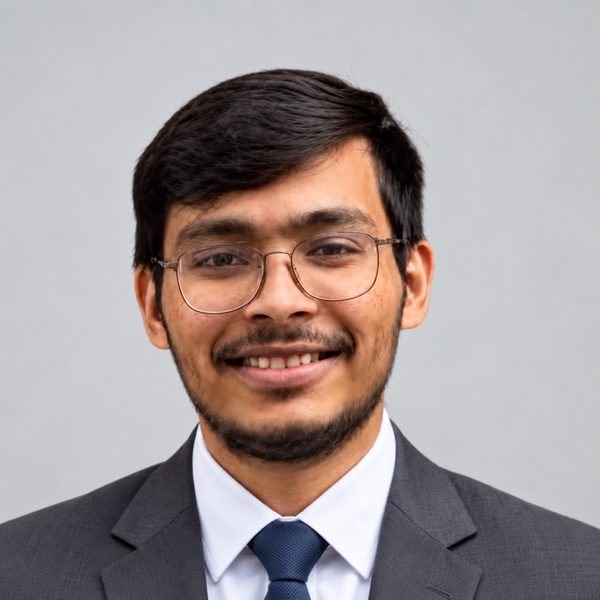
Aditya Maheshwari secured AIR 4 in CA Final and scored 71 in Audit, after an earlier AIR 9 in CA Inter. He learnt Audit from CA Ravi Taori and credits three habits: studying Audit for three to four hours every morning through his study leave, revising earlier lectures and the question bank as he went, and sticking to one set of material instead of chasing marathons or shortcuts.
Key moments in Aditya’s interview
- 0:00 — Intro: AIR 4 and 71 in Audit
- 4:17 — Three habits during regular classes
- 7:41 — Planning the study leave and revision
- 10:52 — How many subjects to study in a day
- 14:03 — Productive hours vs counting hours
- 16:17 — Favourite and toughest Audit chapters
- 18:14 — Retaining Audit: audio revisions
- 19:05 — Answer-writing practice and mock tests
- 20:42 — Exam strategy: descriptive first, MCQs last
- 25:26 — How he tackled the IBS paper
- 29:26 — Do's and don'ts for students
- 32:44 — Final tip: be creative in Audit
How did Aditya study during his regular Audit classes?
Aditya revised the previous one or two lectures before starting the next one, did the question bank alongside the lectures, and never watched too many Audit lectures in one day.
He calls these small revisions “uncounted”: they pile up quietly and make the later full revisions much lighter. Ravi Sir called this cumulative review one of the most valuable points of the interview.
- Question bank with every lecture: about 10 to 15 minutes. No writing, just read the question and answer, and mark anything unique or any extra points.
- Lecture speed: 1.2 to 1.3 for most subjects, up to 1.6 for Audit.
- No binge-watching: too many Audit lectures in a day, he says, only reduces productivity.
How did Aditya plan his CA Final study leave?
Audit came first every day: three to four hours each morning for about six months, followed by one practical subject and one of DT or IDT.
He woke up between 5 and 6 and studied Audit till about 10 or 11 in the morning. He calls himself a morning person, not a late-night student. Because Audit ran daily, he needed a full two-to-three-day Audit revision only twice.
Some days Audit stretched to five or six hours and only a few pages got done. He admits that was frustrating. On those days he took a short break, sometimes a day or two, and started again. He planned day by day, not with long weekly targets, and he did not count hours. A 15 to 20 minute nap, songs or a cricket match helped him reset.
Which Audit topics did Aditya focus on, and did he skip any?
He gave extra time to bulky areas like Professional Ethics, Bank Audit and NBFC Audit, and he did not leave out any topic.
Chapter 1 was his favourite: short, easy and full of good questions. Digital audit troubled him the most. Professional Ethics needed revision again and again because there are so many things to learn.
To retain Audit, he liked audio revisions, since they cover the syllabus quickly and keep screen time low compared to video. He also found Ravi Sir’s image technique for Professional Ethics useful for remembering clause numbers. He did not watch marathon lectures for his main subjects. He revised on his own from what he learnt in the regular classes.
How did Aditya practise answer writing for Audit?
He did not write much early on, but before the exam he took five unit-wise chapter tests and one or two full tests.
The aim was to check how much time he took to think and then to write, so that the exam hall would not be the first place he timed himself.
What was Aditya's exam-hall strategy for the Audit paper?
He wrote the descriptive part first, finished it in about 2 hours 15 minutes, and kept the last 45 minutes for the MCQs.
- Reading time: he skipped reading Question 1, since it is compulsory anyway, and used the time to pick four of the remaining five questions.
- Choosing questions: a quick cost-benefit check of how many marks each question could give.
- Order: Professional Ethics first, because it can be written almost word for word. The more general Planning-type chapters came later.
- MCQs: many Audit MCQs can be answered without going through the whole case study. Even if unsure, two options usually get eliminated.
- After the paper: no paper reviews and no matching MCQ answers. He did it once for DT and it only caused tension.
How did Aditya tackle the IBS paper?
He leaned on the subjects he knew best and avoided case studies where the descriptive questions came from Costing and Law.
He prepared nothing extra for his five core subjects. For Costing and Law he only watched marathon lectures to know where topics sit. He built his own index by customising existing ones and adding points to it.
He also made a master sheet listing each question number with the subject it belongs to, which helped him choose case studies and eliminate options. In the hall he looked in his faculty’s material first, which for Audit was Ravi Sir’s book, and went to the study material only if the answer was not there.
In Aditya’s own words
“The ranks and the scores are always the by-products. You must follow the due course, the due process.” (2:01)
“Before doing the next lecture, I revise what I have studied in the earlier lecture. Your revisions get accumulated, and these remain uncounted.” (4:17)
“If you are watching the clock, your focus is not on studying. Your focus is on increasing the number of hours.” (14:03)
“Don't leave anything. Just read it and go. Leaving something out at the last moment is a bit risky.” (17:45)
“On the last day, what should come from your mind is: this is all that could be done.” (11:43)
“If you read a book multiple times, you get to know whether a point is on the left page or the right page, in the upper part or the lower part.” (29:26)
Aditya’s advice for students
- Revise the last one or two lectures before you start the next one.
- Do the Audit question bank alongside the lectures; just read the question and answer and mark what is unique.
- Stay consistent, even on days when you finish only a page or two.
- Stick to one study material, read it many times, and don't change it because of peer pressure or shortcuts.
- Be creative in Audit and make your own mnemonics and stories.
Frequently asked questions
How many hours did Aditya Maheshwari study Audit every day?
About three to four hours every morning, for most of his six-month preparation. Some days it went up to five or six hours.
Did the CA Final AIR 4 watch marathon lectures?
Not for his main subjects. After the regular classes he revised on his own, and he only watched marathons for Costing and Law to prepare for IBS.
How did Aditya Maheshwari manage screen time during CA Final preparation?
He deactivated Instagram for the six months of preparation. He kept YouTube for amendment lectures, and much of his remaining screen time went on calls and doubt discussions with friends.
Study with the same material
- CA Final Audit FADU Chart Book
- CA Final Audit PARAM Question Bank
- CA Final Audit Titanium Concept Book
- CA Final Audit video courses
Read more students’ journeys — rank holders and comeback stories — on the AuditGuru Success Stories page.
Mast raho. Smart padho. — CA Ravi Taori