


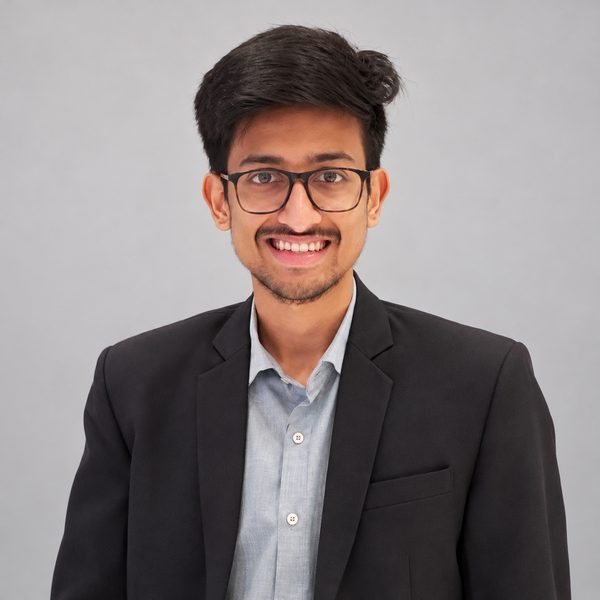
Prasanna Surana secured All India Rank 16 in CA Final and scored 72 in Audit. He started classes early, studied every Audit topic as a flow linked to its heading, and checked his own mock papers with a red pen the moment he finished writing them. He learnt Audit from CA Ravi Taori, took Ravi Sir's fast-track batch and says the FADU Chart Book was his favourite.
Key moments in Prasanna’s interview
- 0:00 — Introduction
- 2:49 — Articleship in M&A taxation
- 5:12 — Handling mobile and social media distractions
- 8:08 — Planning for CA Final
- 15:25 — Key tip: record your own audio notes
- 17:19 — Audit strategy
- 30:05 — The keyword memorisation (ratta) myth
- 41:31 — Multiple revision plan
- 43:47 — Top 3 mistakes students make
- 50:20 — Future plans
How did Prasanna Surana plan his CA Final preparation?
He started classes as soon as he moved to Mumbai for articleship, so that he would have a buffer later.
He compares it to the power play in cricket: if you score 80 or 100 runs early, you can still reach 140 or 160 even if something goes wrong later. People told him he would forget everything by study leave. His reply was that classes taken a year later would be forgotten too, so it was better to finish classes early and start self-study early.
The buffer helped. In between he took a break of about one and a half to two months for CFA Level 1, lost about 22 days to dengue, and spent a month heading a committee for his hostel’s flagship event. FR alone took about eight months. He still did not fall behind.
How did Prasanna approach CA Final Audit?
He treated Audit as a group of its own and split it into three parts: Professional Ethics, Standards on Auditing and the other chapters.
For him, the other four subjects work on concepts. Audit is different, because even when you understand and remember, writing it correctly is the hard part.
- Professional Ethics: no chances. He covered the clauses and also the CA Act part at the start and the Council guidelines at the end. If you know it, you get marks. If you write it wrong, it is zero.
- Standards on Auditing: he enjoyed reading them. He read each SA for its objective, then in a flow: what it is, what the auditor must do, and the reporting considerations.
- Other chapters: topics like investigation and bank audit are straightforward and scoring, so they deserve proper time, not leftover time.
He also practised Audit calculations. When one comes in the paper, he calls it free marks.
What does 'ratta' really mean in CA Final Audit, according to Prasanna?
Ratta does not mean learning every line. It means repeating the points until they all come back together when a question needs them.
His example: if a question asks whether last year’s test of controls can be relied on, you should recall all the points at once – change in personnel, change in IT, the control environment. Most case questions end by asking for factors, so you must know the factors.
If a topic has eight or ten factors, he learnt the five or six that sat in his flow and let the rest go, unless they carried a concept that could come as an MCQ. He did not focus on keywords as such. Keywords alone can make ten sentences with ten meanings, so you need the meaning too.
How did Prasanna mark his books and remember Audit points?
He linked one point to the heading, then built a flow from that point to the next, and marked the flow in his book so he never had to rebuild it.
He used four highlighter colours and two or three pens. He numbered points 1 to 5 and joined them with arrows, so that the next reading was always in the same flow. For a credit card question, screening of the application comes first, and the rest follows from it.
He made his own techniques, some of them odd, and mixed flows, stories, charts and pictures. Relying only on mnemonics, he says, will confuse you. He still remembers the picture-based grouping of clauses from Ravi Sir’s video on memory techniques.
How many revisions did Prasanna do for Audit?
Four rounds for Audit: about 15 days in the first revision, 7 to 8 days in the second, 3 days in the third and 1.5 days before the exam.
His classes took about 120 hours. Before study leave he put in another 30 to 40 hours, and he read Audit for half an hour to an hour on 20 to 25 other days. The first two revisions were more about concepts. The third and fourth were about memorising.
He does not believe in ABC analysis, but he dropped Digital Auditing after two good revisions because its reward-to-effort ratio was very low. He decided this after a mock: he studied Digital Auditing for four hours before it and then could not recall other chapters. He skipped nothing else, not even bank audit.
What mistakes does Prasanna say CA Final students make?
Not writing tests and checking them at once, following a rigid plan, and losing belief in the exam hall.
- Tests and self-evaluation: he scanned and uploaded each paper, opened the suggested answer and checked it himself with a red pen, while it was still fresh.
- Flexibility: update your method every day and fix mistakes in the first revision. The second revision has no room to experiment.
- Self-belief: in a tough paper, collect marks like coins in a game, first MCQs and then whatever you can write in the first hour or so.
He kept his study leave peaceful. He wanted a rank but did not carry pressure about which one.
In Prasanna’s own words
“Revision lectures are someone else's. Your own audio is personalised. You add your own flavour, your own masala.” (15:25)
“In Professional Ethics, if you know it, you get marks. If you don't and you write it wrong, it all becomes zero.” (17:19)
“If I haven't marked something, I haven't read it. If I have marked it, I have read it.” (30:05)
“Reading five points ten times, saying them loudly while walking or sitting, will not do anything. You have to link one point to the heading.” (30:05)
“As soon as I finished writing, I opened the suggested answer and checked my own paper with a red pen.” (43:47)
“When the question paper came in front of me, I would smile on purpose.” (43:47)
Prasanna’s advice for students
- Start early and finish classes early, so self-study can start early.
- Make your own audio of tricky concepts as soon as you understand them.
- Link one point to the heading, then build the flow from there.
- Write tests and check them yourself immediately, while it is fresh.
- In the exam, take one question at a time and collect whatever marks you can.
Frequently asked questions
How did AIR 16 Prasanna Surana study for CA Final Audit?
He split Audit into Professional Ethics, Standards on Auditing and the other chapters, and studied each topic as a flow linked to its heading. He took Ravi Sir's fast-track batch and did four revisions of Audit.
Should I skip any chapter in CA Final Audit?
Prasanna dropped only Digital Auditing in his last two rounds, after revising it well twice, because its reward-to-effort ratio was low. He skipped nothing else, including bank audit.
How did Prasanna Surana control phone use during study leave?
His screen time was about two hours a day. In study leave he uninstalled social media apps and used them only in the browser, where he could not scroll short videos, and he turned off video recommendations.
Study with the same material
- CA Final Audit FADU Chart Book
- CA Final Audit PARAM Question Bank
- CA Final Audit Titanium Concept Book
- CA Final Audit video courses
Read more students’ journeys — rank holders and comeback stories — on the AuditGuru Success Stories page.
Mast raho. Smart padho. — CA Ravi Taori